
(Continuing with the theme of several recent blog posts – subtle energy from the sun, or solar prana)
Yoda the Jedi Master deserves much credit for bringing the notion of an invisible healing energy into our popular culture. His blessing – “May the Force be with you” – could be the official motto of energy medicine and biofield research, but it’s someone else’s take on “The Force” that I want to discuss here. Welsh poet Dylan Thomas wrote a poem in 1933 (at age 19!) called “The force that through the green fuse drives the flower”. It was his description of the primal Springtime energy that stimulates plants to grow (and which is followed by the decay and dissolution, in Nature and in his body, as time marches on). To sense the power behind Thomas’s image, listen to Richard Burton’s reading of the poem here: https://www.youtube.com/watch?v=Ug3m8FHHheo&t=89s&ab_channel=metrisch).
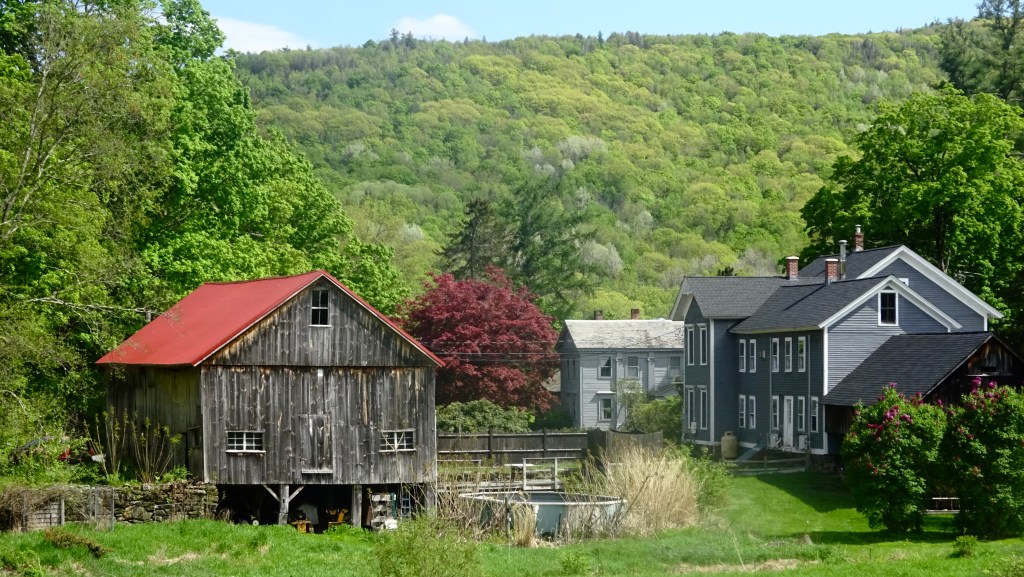
And that force is certainly with us in New England these days, as Spring makes her annual appearance. It’s hard not to be amazed by the energy that is transforming all that surrounds us. Within one short week, we’ve seen dandelions sprout, forsythias blossom, apple trees start to bud, and pastel shades of green show as new leaves begin to emerge. The burst of colors has me wondering if New England shouldn’t be trumpeting its Spring Foliage Season, rather than just focusing on the fall version of leaf-peeping.
A photo of our Spring color palette:
“But what about the science?”, I hear you cry. This contrast between poetry and prose, imagination and science, emotion and logic, is what my high school English class had to confront when we were asked to translate a Robert Browning poem into prose – Pippa Passes, his ode to Spring.
A sentence like “The day’s at the morn and the hill-side’s dew-pearled” became “When ambient temperatures dropped below the dew point at night (typically around 55 degrees in Great Britain in May), condensation was still visible in the morning as tiny spheroids of dew on the blades of Poaceae grass varietals.” And so on. My Inner Science Nerd had a great time turning 8 lines of poetry into 3 pages of single-spaced technical minutiae, making the point that prose is very effective at conveying a lot of objective information, while leaving untouched the emotional/energetic/spiritual core of any experience or event.
So what do we know about the science of “spring fever”, or is that phrase nothing more than poetic license? In fact, spring fever is a recognized clinical condition, and is something more than just the sense of relief that people feel after they’ve survived a “long, cold, lonely winter”. There’s also the fact, for example, that more manic episodes occur in the Spring than at any other time of the year. May’s infusion of new solar energy could easily be the force behind “spring fever”.(https://www.scientificamerican.com/article/fact-or-fiction-spring-fever-is-a-real-phenomenon/).
And its mirror image – the “winter blahs”, or seasonal affective disorder (SAD) – is more common in refions in the northern latitudes that get less sunshine, like Scandinavia. A seasonal pattern exists for circadian rhythms and serotonin levels and sunlight exposure – but is SAD/spring fever a matter of photons or of prana?
One way to sort out their different contributions takes advantage of the fact that sunlight’s photons are absorbed via the skin (where it reacts with melanin to make Vitamin D) and the eyes (which is how phototherapy with full-spectrum light works). On the other hand, solar prana is absorbed with the air when we inhale. It concentrates in the spleen chakra, which then routes it to all the other energy centers (Friedlander 1999)
So we could tease out the different impacts of photons and prana by seeing whether SAD sufferers still benefit from being out in the sunshine while wearing long-sleeved shirts and pants, as well as sunglasses – they’d get prana but no photons. This is obviously a ridiculously impractical study protocol to set up, but it’s possible that breathing in more prana could compensate for the body’s inability to absorb photons through the skin and eyes. It’s just hard to figure out a manageable set-up test this possibility.
This is the same challenge faced by biofield researchers – is the “aura” simply a magnetic field (magnetism being a force that is well-known to physics), or are other subtle energy forces like prana also involved? Teasing out the different factors at work is the #1 challenge to current biofield research in all its domains. Someday, we will understand more clearly how prana and photons work together to create the biochemical energy that fuels our cells by triggering our mitochondria to make ATP (adenosine triphosphate). But for now, though, we’ll just have to stand in awe of this human version of photosynthesis.
But whatever the final explanation turns out to be, as I’m sitting here on the porch and taking in all the sights, sounds and smells of Spring, it’s hard not to agree with Pippa that “All’s right with the world!”
We’ll finish with a few more images of Spring in New England:


(Note: the partially-hidden brown shape in the lower right is our house – a very, very, very fine house, with one cat in the yard….)
Citations:
Friedlander, John and Hemsher, Gloria. Basic Psychic Development: A User’s Guide to Auras, Chakras, and Clairvoyance. Samuel Weiser Press, 1999.
Nicholson C. Fact or Fiction: “Spring Fever” is a Real Phenomenon. Scientific American, March 22, 2007.
Thomas, D. “The force that through the green fuse drives the flower”, read by Richard Burton. https://www.youtube.com/watch?v=Ug3m8FHHheo&t=89s&ab_channel=metrisch
 The Mystery of Life Energy
Leave a comment