
“The sheepdog’s job is to protect the pack and confront the wolf.”
That’s the motto of a new indie film about combat vets called Sheepdog: a soldier is like a sheepdog, protecting civilians and confronting the enemy. This film addresses the important problem of PTSD in returning veterans, but I would probably never have heard of it were it not for a very, very unusual synchronicity that led to my direct on-set involvement in the film’s production. I’m discussing it in this blog because there’s an energy link: the film acknowledges the usefulness of energy psychology to treat PTSD, and will provide some nice exposure for the field of energy psychology. But this blog post will start with a shaggy dog story (one that’s almost as shaggy as a sheepdog) about the synchronicity that triggered the whole process. I’ll then give a quick overview of the movie, and then tie the story in to the mystery of life energy (I’ll also throw in some Hollywood name-dropping for good measure!).
The story began a couple of years ago, when my wife and I woke up to the fact that our living room couch needed to be replaced. The leather stains could no longer pass as abstract art, the couch looked weird in Zoom calls, etc. So we found a new one at a local furniture supply store here in Western MA, and were only slightly dismayed to find out that delivery would be delayed by 6 months due to supply chain issues in China. Six months later, a couch was delivered to us but it turned out to be the wrong size, and the replacement would take another 6 months to arrive. So finally, one year almost to the day after our initial order, the correct couch arrived.
One of the delivery guys, Steven, noticed my wife Doreen’s British accent and asked her where she’s from. Here’s the dialogue, in movie script format (S = Steven, D = Doreen, Me = me):
S: Where in England are you from?
D: London.
S: Oh, I went to school in London.
Me: Which one? (said mostly out of politeness, but with some curiosity)
S: The Royal Academy of Dramatic Arts (said matter-of-factly, even though RADA is the British equivalent of Juilliard – very elite)
Me: (a bit stunned and intrigued, since this wasn’t the typical alma mater of furniture delivery guys) Oh, what did you study there?
S: Acting, and then I got into movie making. In fact, I’m out here for the summer, helping at my mother-in-law’s furniture store while I scout out locations for my new film.
Me: Cool. What’s the film about?
S: It’s about veterans returning home from combat and getting their PTSD treated in a VA clinic.
Me: (more than a little intrigued) Oh, I used to work at the Boston VA Clinic and treat combat vets who had PTSD.
S: We focus on some of the new therapies like tapping and EMDR.
Me: (quite a lot more than a little intrigued) Oh, I’ve been using those techniques for many years in my work.
S and Me: (stunned silence, followed by stammering) Umm, well, ahh, wow, whoa!!!
An animated conversation ensued, spurred by this stunning coincidence. It turned out that shooting would start in a couple of months in nearby Turner’s Falls, and he invited me to serve as the technical advisor for those scenes when those new energy-based techniques were being used, to ensure “artistic verisimilitude” (a lovely phrase from Topsy-Turvy, a 1999 movie about Gilbert and Sullivan). I ended up spending 3 days on set in March of 2023, with my main role being to ensure that the tapping procedure was accurately portrayed by the actress who was playing the role of the VA psychotherapist – Virginia Madsen, a 2004 Academy Award nominee for her role in Sideways (see, I told you there’d be some name-dropping!).
The scenes were fairly brief, but I was able to insert some wording that explained the tapping a bit more clearly, while adjusting her technique so that it was tapping rather than rubbing. Not exactly how a real session would run, but a pretty good 2-minute encapsulation of it.
Going over the script


Tapping
Same for the EMDR session in her office (it’s another new therapy technique in which back and forth lateral eye movements also help to defuse toxic emotions – Eye Movement Desensitization and Reprocessing). I encouraged Steven to slow down the alternately flashing lights that the patient gazes at, in order to be more realistic and look less like fireworks, but he also wanted some pizzaz in that scene so it was a balancing act.
But then my piece was over, while Steven’s team had to finish up the shooting and then the post-production editing. Finally, 18 months after my brief bit, I got to see the finished product last week at the Boston Film Festival. And it was quite a thrill, not only because the movie is excellent in its message and its execution, but also to have an insider’s viewpoint about what was going on in those scenes, and to see how the controlled chaos on the set got translated into a finely choreographed story of complex human emotions and actions.
There are two main envelopes that this movie pushes – firstly, and most importantly, it advances the story of PTSD and veterans, and makes the case for PTG – post-traumatic growth – as a possible, and desirable, outcome from combat trauma (and by extension, any kind of trauma). The fact that 30 veterans and first responders were in the audience of 300 at its Boston premiere, and added their perspectives, and appreciation, during the Q&A to made it even more impactful.
But from an energy psychology point of view, the film represented another step towards the acceptance of energy therapies like EFT by the mainstream, both cultural and medical. I hope the film is picked up by a distributor now, so that it can be shown in theaters across the country (although these days, Netflix and YouTube are pretty effective forums for getting the word out). Not to be too crass about it, but the image of an Academy Award nominee demonstrating EFT will probably do as much to shift our paradigm as any 5 air-tight randomized controlled clinical trials. Ironically, I had planned to take a photograph, while watching the film, of the on-screen moment when Ms. Madsen begins to demonstrate tapping to her patient. But I got so caught up in the drama of the moment that I completely forgot to take out my camera! Same for when my name flashed by in the credits as the “On-site technical advisor to Ms. Madsen” – my 15 seconds of fame, over in the blink of an eye!
So those photos will have to do – the practice session took place just before the scene was shot, and we’re in the diner where she worked part-time (an actual diner in Turners Falls that is really called The Shady Glen), and where Steven’s character has tracked her down to confront her. She is able to defuse the situation by showing him how to tap, but you’ll have to see the film in person in order to see how the scene comes off.
And here are two shots from the reception at the Festival:
Steven and the producer

Rick and Virginia
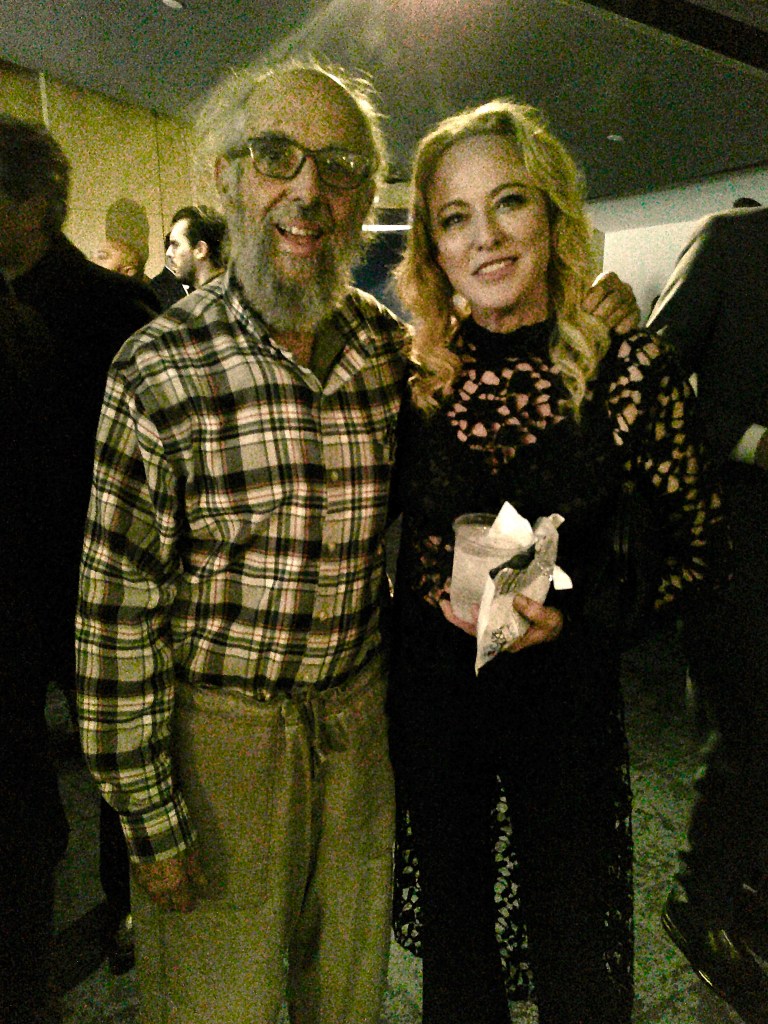
In chatting with Ms. Madsen at the reception, she mentioned that she uses EFT regularly, with her top resource being the copy of John Freedom’s book on EFT that I gave her last year (Freedom, 2012). So thanks go out to John, and to the devas of synchronicity for setting up this nudge to our society so it can become more widely accepting of the mysteries of life energy.
References:
Sheepdog (IMDb): https://www.imdb.com/title/tt9525878/
Freedom, J. Heal Yourself with Emotional Freedom Technique, 2012. https://www.amazon.com/Heal-Yourself-Emotional-Freedom-Technique/dp/1444177184
Hoffman, EL. Over 10 years in the making, Greenfield Recorder, 9/28/24: https://greenfieldrecorder-ma.newsmemory.com/?publink=3adbdf0cf_134d444
 The Mystery of Life Energy
Leave a comment