
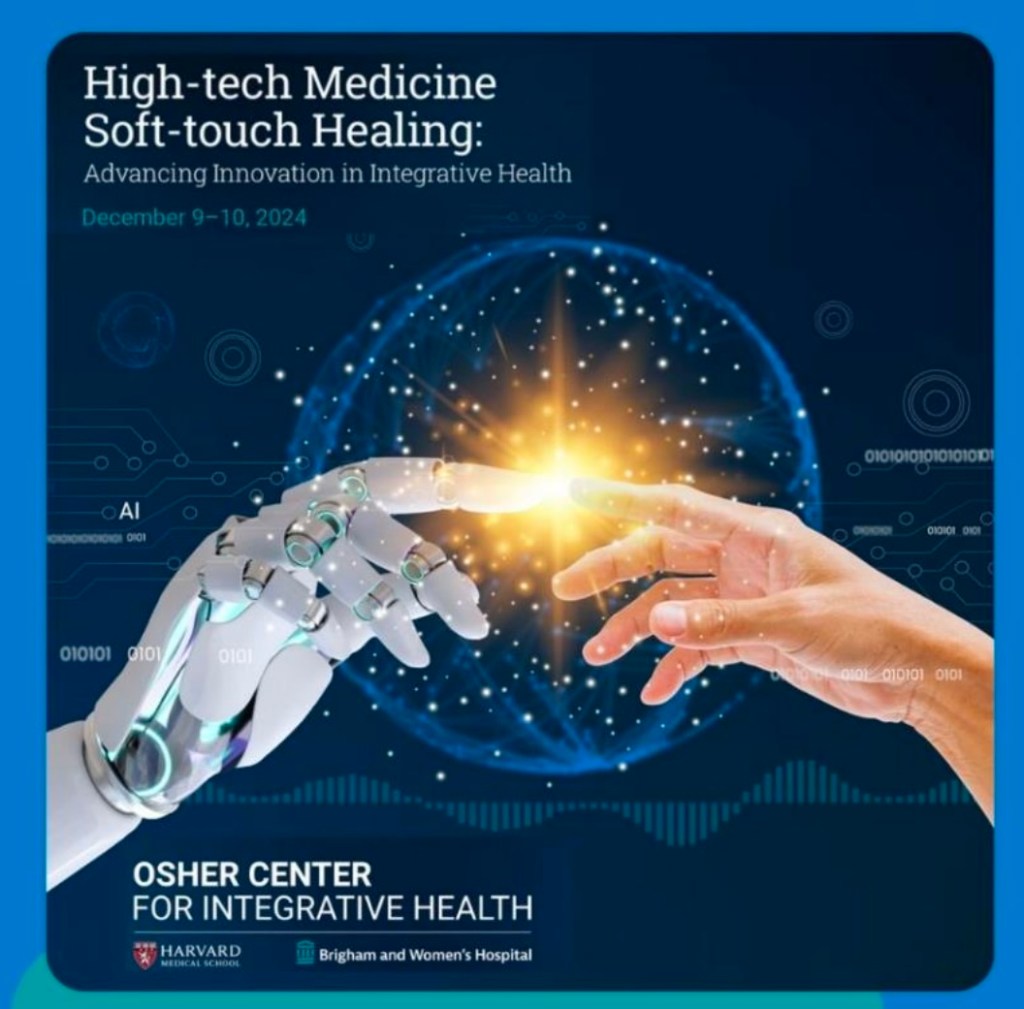
Harvard Medical School coordinates a Center for Research on Integrative Health (that’s the current term for holistic or alternative medicine), and their Osher Institute sponsors an annual Network Forum that allows the scores of practitioners from across the HMS network to meet and learn together.
I was fortunate enough to participate in this year’s gathering, whose general theme was “High-tech medicine and soft-touch healing”. A catchy title, but it left me feeling like an outsider – I don’t even have a smart phone! As it turned out, the forum featured a strong public health emphasis on how access to healthcare can be improved by using internet-based resources (online training videos, group webinars, etc.) along with downloadable apps and wearable devices to track health status. Lots, also, about how artificial intelligence (AI) can facilitate the doctor/patient encounter, and can make data gathering for research more effective.
Which is all well and good, but it left me feeling unsatisfied because its focus on numbers and data seemed to leave out the key ingredient of people and feelings – and life energy. It was very impressive to see how many clinical and research projects are implementing techniques that used to be “far out” in all sorts of community settings – acupuncture, meditation, tai chi, etc. But everything got reduced to quantitative outcome measures and tracking data in a way that left out the human element.
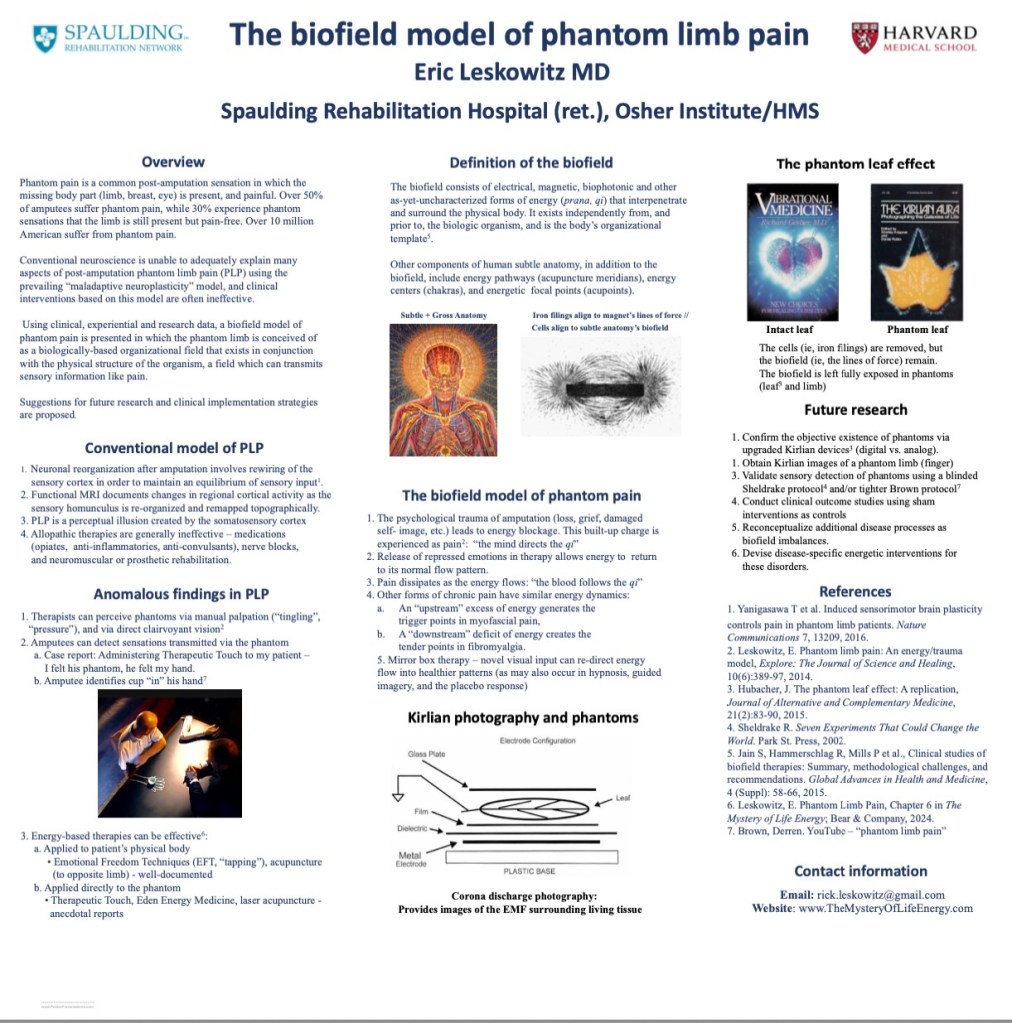
My poster on the biofield aspects of phantom limb pain (based on Chapter 6 in my book), was an outlier in that it was the only one of the 32 talks and 50+ posters to explicitly mention the term “energy” and “biofield” in the title (zoom in to read the text).
One other poster mentioned Donna Eden’s Energy Medicine (the blue circle in the poster line-up below; mine is the blue arrow at the end of the line), but that was as far as Harvard would go towards endorsing life energy.
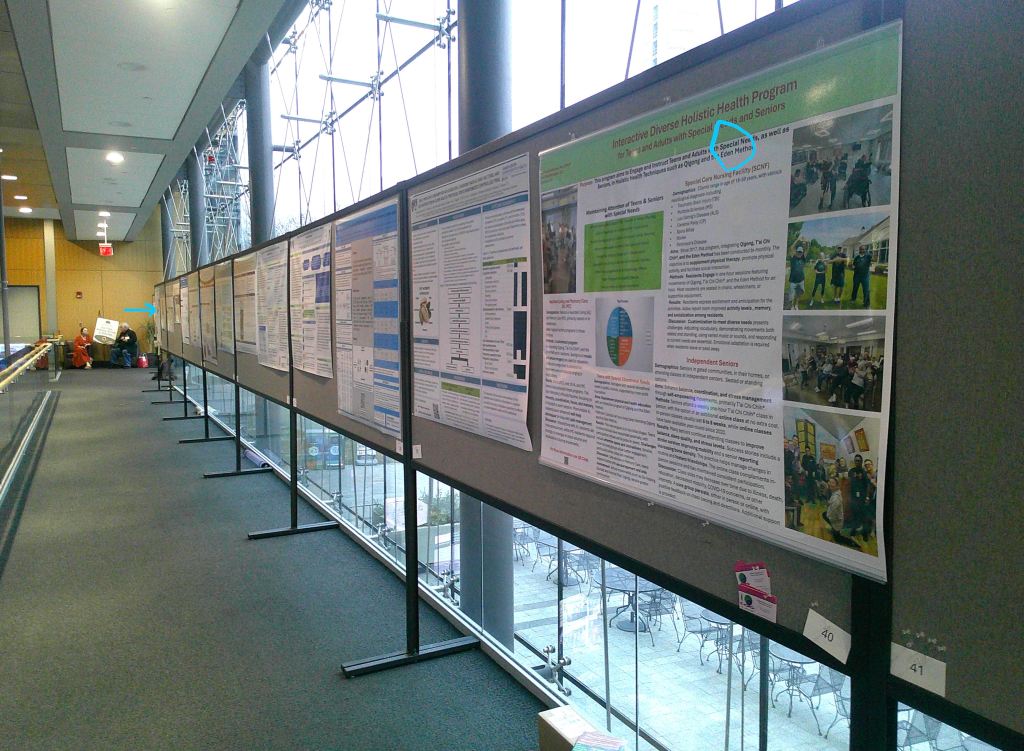
The Osher poster line-up
Other offerings talked about electrical signaling or magnetic fields, but their goal was always to reduce subtle energy phenomena to physical forces, with no room for consciousness or spirituality or non-local effects. The full program is here – see for yourself: https://whova.com/web/GKkg8xHiyKWLxDa0Oiao%40xMm1-zgpHyvpuDWiKRJZtQ%3D/
So it was ironic that the standout moments of the event, for me, all involved the non-tech aspects of the event, and the non-digital analog aspects of being human.
1. Attending in person – 750 people registered for the event, but only 100 attended in person. We all received access to the same information, but the online hybriders missed out on the key ingredient – the energetics of social interactions and interconnections.
2. The overall atmosphere – the “vibe” of so many people gathered together to explore an exciting new field was upbeat and healing. One attendee told me, in the course of several chats along the way, how she felt that “negative energies” coming from her ex had been wearing her down for months, but had gradually loosened and disappeared during the course of the event. Healing vibes!
3. Meeting someone in person – a colleague who I had gotten to know via 5 years of monthly Zoom calls looked very different in person! We practically had to pinch each other’s cheek to make sure we were real, another example of how life is more than datasets.
4. A reunion – I shared a nice hug with a former colleague whom I had known in person for over 10 years, but had only seen virtually for the past 5. In person is more alive than Zoom, of course, but it’s hard to pin down what that difference is. It’s intangible and something of a mystery – just like life energy.
5. Not everything is quantifiable – making a computer model of tai chi movements as recorded with electrodes and telemetry helps to determine how accurate the movements are, but is the qi energy actually flowing, or is it just a robot in action? Right now, the best way to assess energy now is via self-report or an energy-sensitive person’s perceptions, but hopefully we’ll have reliable devices in the not-too-distant future than can accurately track energy dynamics.
6. Synchronicity – A woman looking at my poster read about my connection to Spaulding Rehab and told me how her mother had gotten such good care there. The attendee herself had been treated at one of our outpatient clinics, and still remembered how exceptional her PT there had been. It turned out to be the same clinic I’d worked at (Medford), and her PT there was the fellow mentioned in #4, who at that very moment was rounding the corner of the hallway for a pre-arranged meeting with me. He came into view just as she finished describing her therapy with him, and the happiness with which they greeted each other was the high point of the conference for me.
Their meeting wasn’t quantifiable, though their heart-rates probably increased and their brain waves also did something or other. And it wasn’t a pre-scheduled appointment set up by their electronic medical systems – it was a lovely, non-quantifiable synchronicity. And their spontaneous show of emotion embodied the reasons why people go into healthcare as a vocation in the first place (“vocation” is Latin for “a calling”). Sadly, my PT colleague had just been telling me how his computerized record keeper can track how much time he spends writing up each progress note, and he had been admonished by his supervisor for spending 9.4 minutes per note, when the national average is only 8.0. I didn’t know whether to laugh or cry.
Conclusion: AI has a lot to offer, but it leaves out the key ingredient that make us human. Oy!


 The Mystery of Life Energy
Leave a comment