
The 2026 Winter Olympic Games in Cortina Italy have just finished, and they offered up such a wide range of experiences relating to life energy in its many forms that I’ve written this blog post about them. Sport is a forum for the full range of human experience, so here are some thoughts on sport and society. They range from a look at how individual athletes get into the Zone of peak performance, to the sort of group energy coherence that can bring a team a gold medal, to the global sociopolitical awarenesses that are raised by the Olympics. These gleanings come from someone who is admittedly not a big fan of winter sports, but even if you, the reader, are not the sporting type, I think there’ll be something here that you resonate with.
In America, sport (and society) is a matter of winners versus losers, good guys (the home team) versus the bad guys (the visitors). We’ve put a military spin on the word “competition”, overlooking its original meaning: the Latin “com-“ means “together”, and “petere” means “to strive”. So true competition is a matter of striving together for a shared goal – excellence, harmony, enjoyment – not Us vs. Them, and defeating the Enemy. So how did that dynamic play out in Italy last month?
Another nation’s POV: Let’s start with a look at the nation with the most un-American view of sports – Norway. They had a disproportionate medal haul – more medals than any other country, even those with double, triple and ten-tuple their population (60-fold, for the USA). They have well-organized government-supported sports programs from youth on up (especially winter sports, given the climate), but their focus isn’t on winning – it’s on having fun. In fact, teams don’t even keep score until the kids are 12 years old, and everyone gets a trophy (literally). 90% of their young children are active, as are over 70% of teenagers, compared to 30% of American teens(!). This goes along with a similar flip in online screen time for American versus Scandinavian teens.
As a former British Olympian noted:
“(Norway) avoids the damaging separation of children into those with “talent” and those traumatized by dropping the ball and being left out of teams…Research shows that the biggest reason why kids drop out is it stops being fun. It’s really that simple…. If we helped every child to love sport, we would get both better athletes and healthier humans.”
NBC Sports looked into “The Nor-Way” of emphasizing fun over victory; their 6’ video clip is fun to watch.

NBC interviews the kids
And apart from emotional well-being, there are huge public health benefits to this approach, especially with lower rates of obesity and heart disease, showing that national attitudes to sports can have a big impact on many different aspects of life.
The champion who chose joy: One athlete – American, not Norwegian – made the quest for fun her primary competitive goal. The women’s figure skating event featured the most colorful of the performers, and that’s not just referring to her gold-striped hairstyle. Alysa Liu was also the most exuberant and joyful of the skaters, and she often talked about how attaining a sense of happiness while skating was her most important goal in competition. Her backstory is pretty unusual, too: after winning the US championship at 13(!) and retiring at age 16(!!), her pursuit of joy led her back to competition and to an Olympic gold medal. Here are some of the commentaries she inspired with her exuberant performances:
• The science that explains why we all love Alysa Liu.
ª Has anyone ever been happier?
• Joy is a competitive superpower
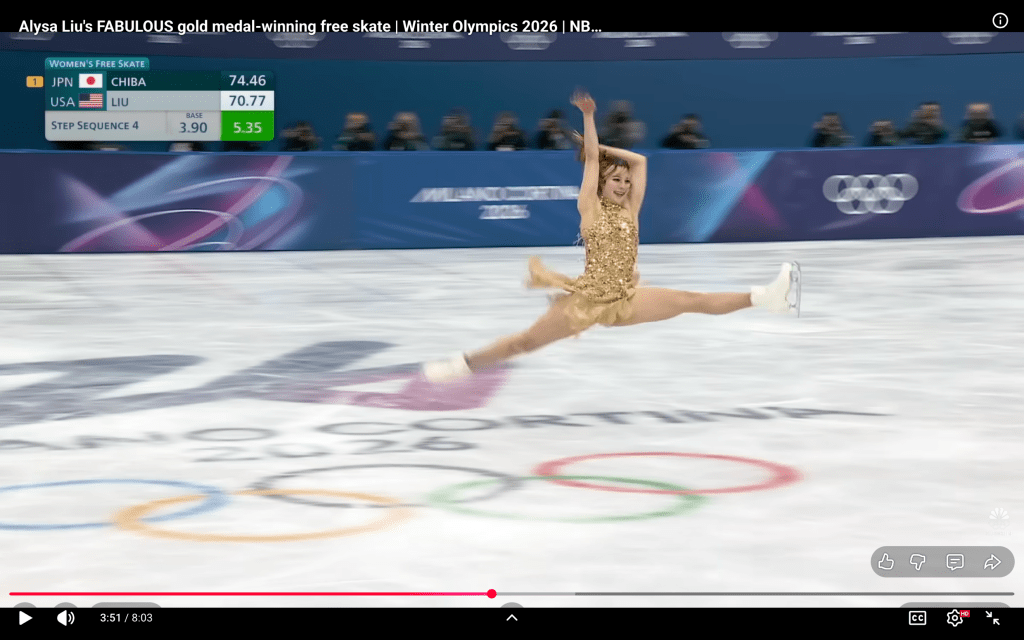
Alysa in action (her full 8’ routine is here)
Connecting with happiness propels her into the Zone, and she doesn’t even have to strive to enter that flow state – it’s effortless and beyond ego. There are echoes of Canadian Olympic sprinter Robyn Meagher’s catchphrase: “love is a competitive strategy” – a true Zen koan (hear Robyn and her colleagues in the Evolutionary Sports Collaborative discuss this and other aspects of the Games in their recent post-Olympics roundtable).
Their book on sports, energy and consciousness is also worth a look. Getting into the Zone is easier when you’re happy – end of story!
Self-sacrifice: While Alysa transcended her ego in the altered state of consciousness known as joy, another way of putting aside the concerns of ego was shown by American skier Lindsy Vonn. She was a prime example of how striving can be so extreme that the safety of the body is put in jeopardy. She has dominated her sport since her first gold in the 2008 Olympics, and was favored this year too, until an injury in her last training run prior to the Games left her with a torn knee ligament (ACL). Most athletes, and most normal human beings, would have said some version of “Damn, what @#$%ing bad luck! Maybe next year”. Even NFL football players have the surgery and then rehab for 6-9 months before returning to play.
But Vonn took all of one week to let the swelling to go down, determined that her knee would still be strong enough to ski on, and went right back to competing. And compete she did – for all of 13 seconds, until she clipped a gate in the downhill final and wiped out once again. But this time her injury was more extensive, including a fractured tibia (shin bone). She had to be evacuated by helicopter, and the Italian hospital performed 4 surgeries to save her knee before she could even fly home to America for rehab. She admitted that she had faced the possibility of a amputation this time, but said it was worth the risk because competing was her top priority – no time for worrying about health and safety.
Individual courage: Another form of selflessness involves sacrificing personal success for a higher purpose. For me, the most courageous action during these Games was embodied in the helmet worn by Ukrainian skier Vladyslav Heraskevych. He pasted images of several of his friends on the surface of the helmet, and that mundane act caused a controversy because these friends had recently died in the war with Russia. His memorial gesture was taken to be an overt political statement of the sort that is forbidden by the International Olympic Committee. He was given the chance to remove the images from his “helmet of memory” before the event started, but he opted to keep them on in homage to his countrymen. So he was disqualified and could not fulfill his life’s dream of competing in the Olympics. But he went home a hero, receiving the Order of Freedom medal from President Zelenskyy, and the respect of the rest of the world.
Too much attention: The downside of successful striving is too much publicity. 21-year old figure skater Ilya Malinin had not lost in competition for over two years going into Cortina, and had generated so much publicity for his unprecedented quadruple spin jump that he was referred to as “The Quad God”. And yet, as often happens to human beings when placed on a pedestal, the inconceivable happened and he fell on his first jump in the finals, never recovering his composure and the lost points, finishing 8th. He was in good spirits afterwards, though, and remarkably offered no excuses to prop up what would have been for most people a severely damaged ego. One songwriter was so impressed by this attitude that she wrote a song about his dilemma that went viral, calling it “Momma, I’m a mortal”. And so he is, media hype notwithstanding.
Sportswashing – And then there’s the political side of the multi-billion dollar enterprise known as world sporting events. First there was whitewashing (covering up uncomfortable truths with spin and propaganda), then greenwashing (big polluters rebranding as eco-friendly), and now we have sportswashing. The leaders here are Gulf State oligarchs: they literally purchase respectability in the West by buying up ownership of popular sports teams (UK Premier League football powers Manchester City and Newcastle United), setting up an entirely new rival golf league (the LIV, offering gigantically inflated prize money), and lobbying (ie, bribing) various governing boards to gain the rights to host premier events like the soccer World Cup (Qatar 2022) and the Women’s Tennis Final (Riyadh 2025). Shaking hands with respected world leaders on camera is, at one level, simply a distraction from their abysmal human rights records and their stranglehold on the world’s economies. But so far, it seems to be working.
Scandals: I could devote an entire post to the scandals of these Games – accusations of biased judges, a national leader playing sexual politics by praising his country’s men’s hockey gold medal while joking dismissively about their women’s gold (President Trump, in case you were wondering), shoddily-made medals that broke in half, condom shortages in the Athlete’s Village, and claims of cheating in the normally staid world of curling.
But the topper involved male ski jumpers who hoped to gain an aerodynamic edge by inflating – literally – their front ends. Cosmetic filler has been used medically in “penile girth enhancement surgery”, and that same technique was used here to necessitate a larger size ski suit, one that created more air friction and thereby generated greater lift and distance. Not surprisingly, the media called this scandal “Penisgate”, and no, I am not making this up.
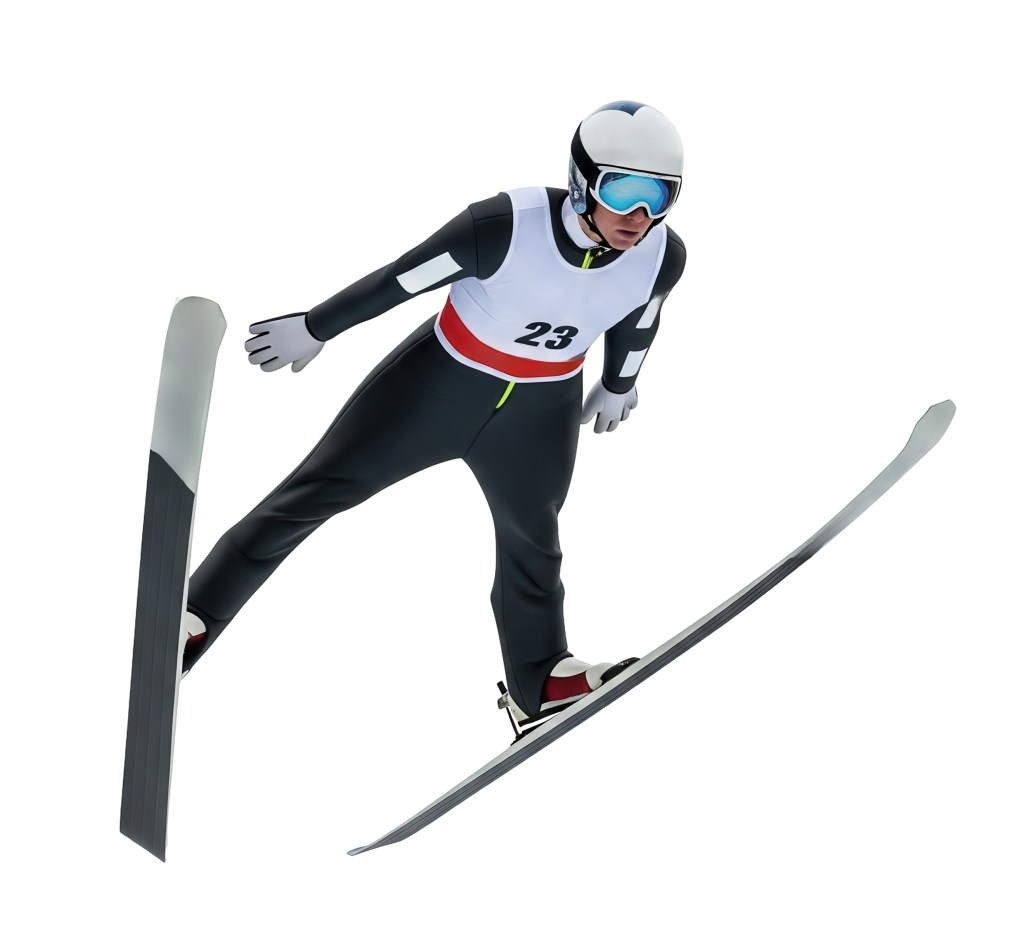
One of those jumpers?
Bottom line – Sports has always been a reflection of society, embodying the full range of human behavior – from selfishness and narcissism to courage, sacrifice and transformation. In our current time of polarization, it can also be a sanctuary, a safe forum where people of different political views can come together to talk, and to appreciate fellow humans who are striving together to reach their highest ideals.
 The Mystery of Life Energy
Leave a comment